Guide
The airlines that fade in the evening, and the ones that hold
Southwest's dawn flights ran 93.4% on time and its 5pm to 8pm flights 62.7%. Delta fell from 90.0% to 74.0%. Which airlines lose the most by evening, and why.

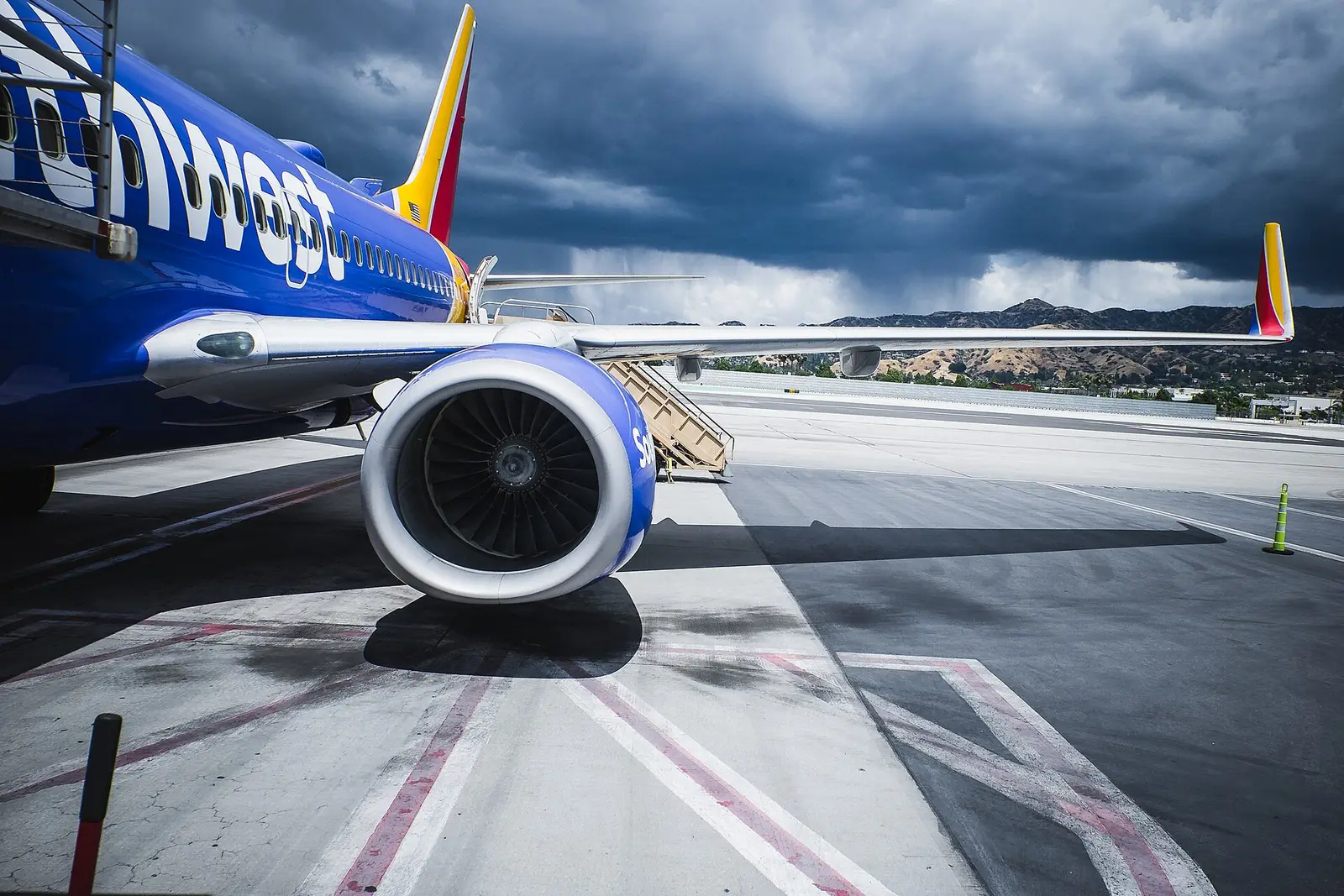
A Southwest flight scheduled to leave between 5am and 8am arrived on time 93.4% of the time over September 2025 to August 2026, the best first-wave record of any large US airline. A Southwest flight scheduled between 5pm and 8pm managed 62.7%. Delta started lower, at 90.0%, and finished far higher, at 74.0%.
By late morning the two airlines have swapped places.
The best time of day guide explains why flights get later as the day goes on, and the departure time guide ranks the airports where it matters most. This guide asks the airline question: whose schedule holds up into the evening, whose collapses, and whether the reason is the business model or the map. My reading of the data is that the map matters at least as much as the business model.
Fourteen airlines, six windows
On-time percentage. Darker means more delays; the best cell in each row is outlined.
| 5am-8am | 8am-11am | 11am-2pm | 2pm-5pm | 5pm-8pm | 8pm-5am | |
|---|---|---|---|---|---|---|
| Delta | 90 | 86 | 82 | 77 | 74 | 76 |
| Envoy | 89 | 86 | 82 | 79 | 74 | 76 |
| Hawaiian | 88 | 83 | 80 | 76 | 80 | 77 |
| Alaska | 87 | 82 | 78 | 77 | 75 | 79 |
| United | 90 | 84 | 81 | 73 | 69 | 75 |
| SkyWest | 87 | 82 | 80 | 75 | 72 | 77 |
| Republic | 89 | 85 | 80 | 74 | 69 | 70 |
| Southwest | 93 | 86 | 77 | 68 | 63 | 63 |
| American | 88 | 82 | 75 | 68 | 65 | 67 |
| Allegiant | 91 | 85 | 76 | 68 | 61 | 59 |
| PSA | 86 | 81 | 75 | 68 | 64 | 65 |
| Frontier | 84 | 79 | 76 | 70 | 64 | 65 |
| Spirit | 85 | 78 | 72 | 67 | 63 | 65 |
| JetBlue | 87 | 80 | 70 | 64 | 60 | 63 |
Rows ranked by full-year on-time rate. Windows run 5am, 8am, 11am, 2pm, 5pm and 8pm to 5am local time. Source: US DOT Bureau of Transportation Statistics, September 2025 to August 2026.
Read the first column and the airlines barely differ. Most of them get somewhere near nine in ten dawn departures to their destination on time; Frontier, at 84.2%, and Spirit, at 84.6%, trail the field. Read the fifth column and they spread out. Hawaiian is in a category of its own at 79.8%, flying short sectors in a closed island network. Among mainland airlines, Alaska at 75.3% and Delta at 74.0% hold up best. JetBlue (59.9%), Allegiant (61.1%), Southwest (62.7%) and American (64.5%) finish at the bottom, alongside Spirit, Frontier and PSA.
The practical consequence: the choice of airline is worth far more in the evening than in the morning. At dawn you can book almost anyone.
After 5pm the carrier is the decision.
Who falls furthest
5am–8am5pm–8pm
50.0%100.0%
On-time percentages for flights scheduled 5am–8am and 5pm–8pm, ranked by the size of the fall. Source: US DOT Bureau of Transportation Statistics, September 2025 to August 2026.
Southwest and Allegiant fall furthest, by 30.7 and 29.6 points respectively, against a median of 20.1 points for the 14 airlines. JetBlue follows at 27.1 points, and so, perhaps surprisingly, does American, a hub-and-spoke network, at 23.8. At the flat end are Hawaiian (8.6 points), Alaska (12.1) and SkyWest (14.2).
The obvious explanation is aircraft rotation. Southwest's aircraft fly point to point, several legs a day, with turns kept as short as the operation allows. The 7am departure is an aircraft that spent the night at the gate. The 6pm departure is often an aircraft on its fourth or fifth leg, and every delay it picked up along the way is still with it, because a short turn leaves no room to win time back. Late-arriving aircraft account for 51% of Southwest's delay minutes, against 40% nationally. The Southwest guide covers its record station by station.
Where the rotation story breaks down
If rotation alone explained the fade, the ultra-low-cost carriers would top the chart. They fly long days with few spare aircraft. They do not. Spirit falls 21.2 points and Frontier 20.1, both less than American. Their problem is a different one: they start the day weaker, with Frontier's first wave the weakest of the fourteen in this period, and stay weak. A Frontier or Spirit evening flight is not much worse than a Frontier or Spirit morning flight; both are worse than most airlines' mornings. The low-cost carrier guide covers why.
One caveat on Spirit: its filings stop in early May 2026, so the data has no Spirit flights in June or July 2026. Its evening figure has not been through a full summer of thunderstorms, and I would not read its fade, smaller than American's, as proof of anything until it has.
The regional airlines complicate the story from the other side. Regionals typically fly more legs a day than anyone, on short hops with quick turns, yet SkyWest and Envoy are among the flattest curves in the country. Part of the answer is hub support: regional aircraft return to a hub between most legs, where the mainline partner keeps spare aircraft and reserve crews. Part of it is the map, which the next chart makes plain.
The same airline, different airports
5am–8am5pm–8pm
35.0%100.0%
On-time percentages for departures from each airport scheduled 5am–8am and 5pm–8pm. Source: US DOT Bureau of Transportation Statistics, September 2025 to August 2026.
Southwest's fade is not uniform. At Southwest at Boston and Southwest at Denver the evening falls off a cliff; at Southwest at Long Beach and Burbank it falls far less than the national average, and at Southwest at Honolulu barely at all. Same airline, same fleet, same turn times. The difference is what the aircraft flew into during the day: Boston and Denver evening departures are built from aircraft that spent the afternoon in East Coast and Rocky Mountain thunderstorm airspace, while the Southern California bases mostly swap aircraft up and down a coast with little afternoon convection. That is inference, but it is consistent with the airport-level curves.
SkyWest shows the same thing in reverse. SkyWest at Salt Lake City is almost flat from dawn to dusk. SkyWest at O'Hare, its single biggest station, falls much further. SkyWest's flat national curve reflects where the rest of its flying is: Denver, Los Angeles, Salt Lake City, San Francisco and Seattle, where evenings hold up better. Its evening flights into O'Hare, such as OO 4808 from Peoria, were among the least punctual regular flights in the country. I would not put a tight connection behind that flight.
American's steep curve fits the same pattern. American at Orlando and American at Denver fall hard by evening; American at JFK much less. American's network runs through Dallas-Fort Worth, Charlotte, Miami and O'Hare, four hubs with severe summer afternoons. Its evening problem is at least as much geography as business model. Its 6:20pm from Dallas-Fort Worth to Orlando, AA 2186, was among the least punctual regular flights of any airline.
After 8pm
The last window splits the airlines again. Alaska, SkyWest, United and Delta recover after 8pm: 79.0%, 76.5%, 75.0% and 76.1%. Their late departures include West Coast flights and red-eyes leaving after the evening peaks have cleared. Southwest and Allegiant keep falling, to 62.5% and 59.3%. Their last departures of the night are aircraft finishing a full day's rotation, with nothing between them and the end of the schedule to absorb the delay.
Frontier and Spirit schedule a large share of their flying after 8pm, and it runs about as well as their evening flights: 65.0% and 65.0%. For these carriers the late-night window is not a recovery. It is more of the same.
What I would book, hour by hour
One year of data covers one summer of thunderstorms, and a single bad July at one hub can move an airline's evening figure several points. The ranking of the steep and flat airlines is structural, though, and unlikely to change much.
Before 8am, book on price. The first wave ran well at almost every airline, and Southwest led it.
After 2pm, book on the airline. Delta and Alaska on the mainland, Hawaiian between the islands. On routes with a choice, compare the carriers on the route's own page: on Nashville to Denver, United beat Southwest mainly because of Southwest's evening departures.
Treat Southwest evening flights by station. From Boston, Denver or Nashville, I would avoid a Southwest evening departure if anything that day depends on it. From Long Beach or Burbank it gives up far less.
Do not expect the late-night flight to rescue a low-cost itinerary. On Southwest and Allegiant the last flights of the night are the weakest of the day; on Frontier and Spirit they are no better than the evening.
For a connection, the fade compounds. A Southwest or JetBlue itinerary that connects at 5pm stacks two of the weakest windows on the same day; the best time to fly tool shows the hour-by-hour record for a specific route.
Compare the airlines: Southwest · Delta · JetBlue · American · Alaska · SkyWest · Best time to fly tool