Guide
The best time of day to fly, according to 7.05 million flight records
Departures between 5am–8am arrive on time 89.3% of the time. The 5pm–8pm window manages 68.0%. Here is why the gap exists and how to use it.

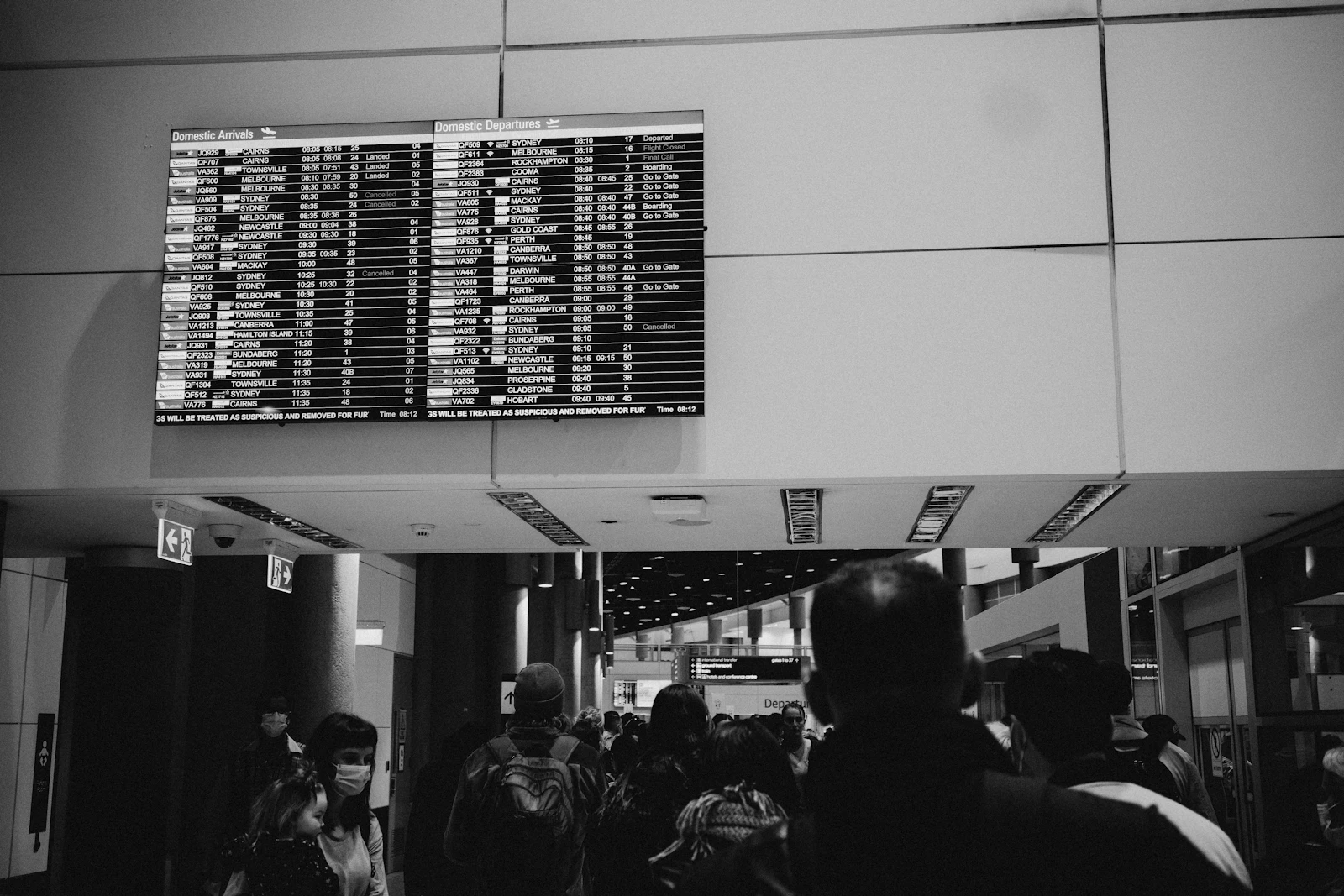
Across 7.05 million US domestic flights between September 2025 to August 2026, departures scheduled between 5am–8am arrived on time 89.3% of the time. Departures in the 5pm–8pm window managed 68.0%. That is a spread of 21.3 percentage points, available to anyone willing to set an alarm.
Almost no other booking decision moves the number that far. Choosing between two carriers on the same route usually buys three to eight points. Choosing between a morning and an evening departure on the same carrier, on the same route, in the same aircraft type, routinely buys more.
The reason is mechanical, not mysterious
An aircraft flies four to six legs a day. The first one leaves from a gate where the plane spent the night. It has no inbound flight to wait for, no crew stuck on a delayed inbound, no cascading turn to absorb. Everything that could have gone wrong the previous evening was absorbed by the overnight.
By mid-afternoon, that same tail number has flown three legs. Each turn had a scheduled ground time of forty to fifty minutes, and each one was an opportunity to lose ten minutes and not get them back. Airlines build a little padding into block times, but not enough to erase three accumulated delays. The fourth leg of the day inherits everything the first three could not shed.
This shows up directly in the DOT's own delay-cause reporting. Nationally, 40% of all reported delay minutes are charged to "late-arriving aircraft", which means precisely this: the plane was already behind when it got here. That category is not weather, and it is not the airline making a mistake this afternoon. It is arithmetic catching up. That is how I read the category whenever it tops an airport's cause breakdown: not bad luck on the day, but the schedule's earlier legs arriving late.
Air traffic volume compounds it. Departure banks at large hubs cluster in the late afternoon and early evening. A runway that handles 40 departures an hour comfortably at 7am is sequencing 60 at 5pm, and the queue is the delay.
What the curve actually looks like
The national pattern, block by block:
- 5am to 8am is the strongest window almost everywhere.
- 8am to 11am holds up well. The first bank has cleared; the second has not yet fallen behind.
- 11am to 2pm is close to the daily average.
- 2pm to 5pm starts to slide.
- 5pm to 8pm is the weakest window at most airports, and by a wide margin at congested ones.
- 8pm to 5am recovers. Red-eyes fly into empty airspace, and a midnight departure is often the aircraft's first leg of a new duty day rather than its last.
The overnight recovery surprises people.
It should not. A 11:40pm departure faces no arrival bank, no ground stop, and no queue. The reason it does not appear on more itineraries is that few people want to arrive at 6am, not that it performs badly.
Where the effect is strongest
The curve is steepest where congestion is the binding constraint. At Newark (EWR), LaGuardia (LGA) and San Francisco (SFO), the airport is running near its practical capacity for most of the operating day, and every delay in the morning bank is still being paid off at 7pm. At a mid-size airport with a spare runway and a schedule that never saturates it, the difference between the first and last departure of the day is a few points rather than fifteen.
Weather changes the shape too, seasonally rather than daily. Summer thunderstorms in the Southeast and Texas build in the afternoon and peak between 3pm and 8pm, which lands squarely on the weakest window and deepens it. In January the curve is flatter, because a winter storm shuts an airport for the whole day rather than for six hours of it.
How I use the clock when I book
The honest version of the advice has limits attached.
Take the earliest departure you can tolerate, but do not connect through a hub with a 35-minute layover just because both legs are early. The buffer matters more than the hour.
If the trip has a hard deadline at the other end, a job interview, a cruise departure, a wedding, fly the day before. Even the best route-and-hour combinations with a meaningful sample, mostly dawn departures on quiet routes, top out in the high 90s. The best you can buy is better odds, not certainty.
If you are choosing between an 8am on a weaker carrier and a 6pm on a stronger one, I would take the 8am every time. The time-of-day effect is usually larger than the carrier effect on the same route, and the two are not additive in the way people assume.
And check the specific route rather than assuming the national pattern. The curve on a two-hour transcontinental feeder does not look like the curve on a 400-mile shuttle flown eight times a day. Every route page on this site shows its own six-block breakdown with the sample size behind each bar. Check the direction you are actually flying, too: the pipeline stores the two directions of a route as separate records, which is why LAX to SFO and SFO to LAX can differ by ten points.
The part nobody advertises
Airlines know all of this. It is why the first departure of the day is frequently the most expensive one on a business route, and why the 6:15pm departure on a Thursday out of a major hub is priced to move. You are not being offered a bargain on the evening flight because the airline is generous. You are being offered a discount on the seat with the worse odds.
That is a fair trade if you know you are making it. The point of the number is to let you decide, rather than discovering the pattern the third time you sleep at an airport hotel.
Check the specifics for your trip: Delta's on-time record · Chicago O'Hare (ORD) delay statistics · Compare any US route