Guide
St. Louis and Kansas City airports: Southwest country compared
Kansas City ran 80.0% on time over September 2025 to August 2026 and St. Louis 77.4%. Southwest flies most of both, and its evening is where the two airports lose their time.

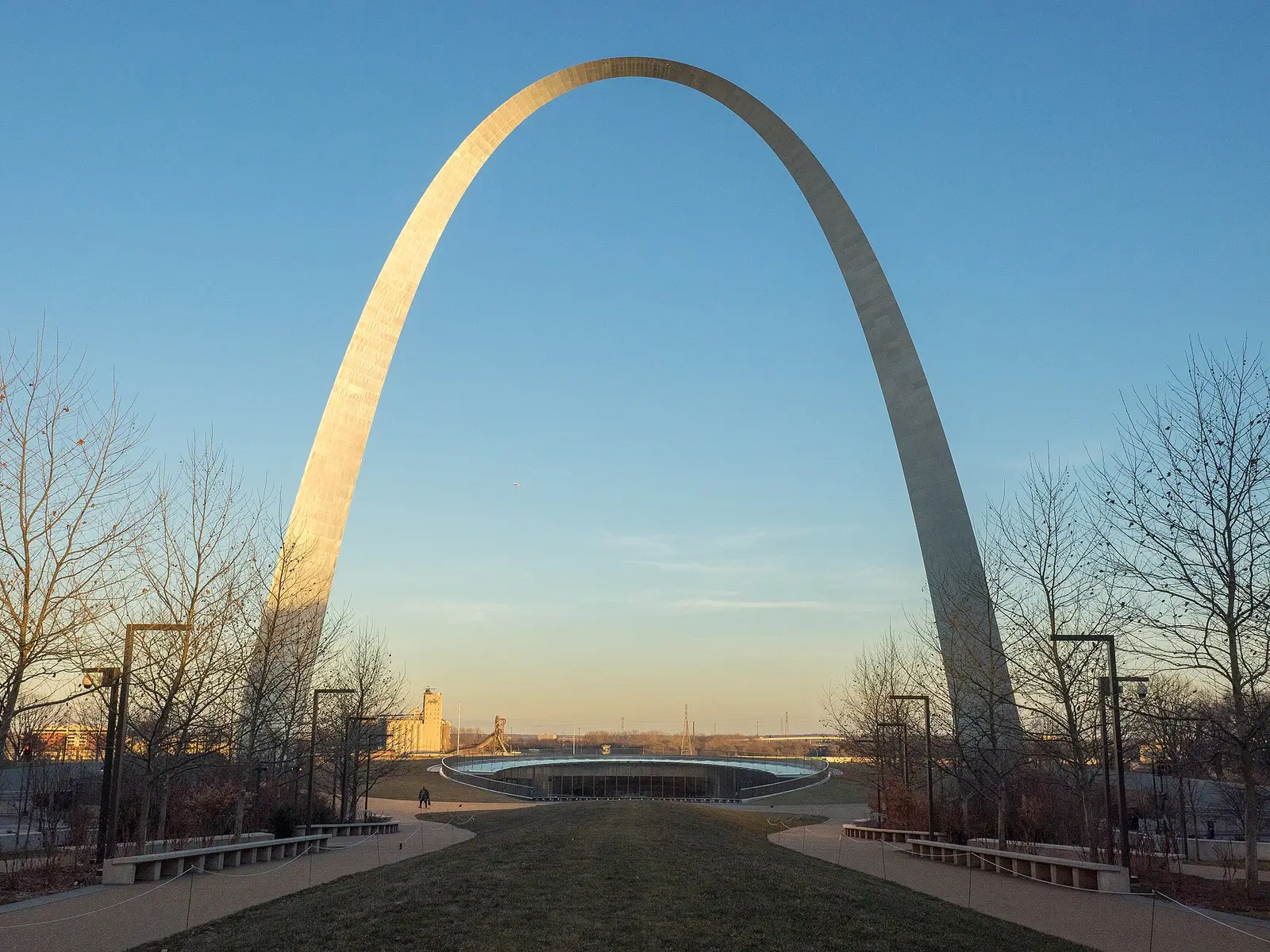
Southwest flew 1,391,794 scheduled flights across the US over September 2025 to August 2026, and at St. Louis it runs more than three departures in every five. Kansas City, 240 miles west along I-70, is not far behind at nearly half. Two Missouri airports, one airline in charge of both, and yet Kansas City ran 80.0% on time and St. Louis 77.4%: rank 17 and rank 37 of the 60 airports on this site.
On everything else they are close. St. Louis Lambert cancelled 1.32% of its departures and Kansas City International 1.52%, against 1.89% nationally. Late flights averaged 69 and 72 minutes behind, a little shorter than the national 73; Southwest's own late flights at both airports ran far shorter than that, its usual profile of frequent short delays rather than long ones. 7.7% of St. Louis departures arrived an hour or more late against 6.8% at Kansas City. The figures are for departures, scored on arrival.
One airline sets the pace
STL average 77.4%
60.0%90.0%
Departures from STL. The dashed line is the airport average. Source: US DOT Bureau of Transportation Statistics, September 2025 to August 2026.
At St. Louis, Southwest at STL runs so much of the schedule that the airport average is essentially Southwest's number. Delta, with a fraction of the flights, led the airport by a wide margin; American, the former hub carrier here, also beat the average, while SkyWest and Frontier trailed. St. Louis was a TWA and then American hub until American cut it back in 2003, and Southwest has filled much of the space since.
MCI average 80.0%
70.0%90.0%
Departures from MCI. The dashed line is the airport average. Source: US DOT Bureau of Transportation Statistics, September 2025 to August 2026.
Kansas City has the same leader. Delta at MCI ran well ahead of the airport, as did Alaska on its handful of Seattle flights, while Southwest at MCI sat a little below the average. The difference between the two airports is mostly Southwest itself: its Kansas City operation ran better than its St. Louis one, and both sat near Southwest's network average of 75.7%. The one real outlier in either carrier table is PSA, American's regional, which cancelled more than any other carrier at both airports.
The Southwest curve
St. Louis (STL)77.4% overall
Kansas City (MCI)80.0% overall
Southwest Airlines at STL75.9% overall
Southwest Airlines at MCI78.1% overall
All panels share one scale. Source: US DOT Bureau of Transportation Statistics, September 2025 to August 2026.
Before 8am, St. Louis ran 90.1% on time and Kansas City 91.3%. Between 5pm and 8pm those fell to 67.8% and 67.5%, and after 8pm to 64.1% and 63.0%. Kansas City's morning-to-evening gap of 23.8 points and St. Louis's 22.3 both exceed the national 21.3.
Southwest drives the shape. Its dawn departures from both airports are among the most punctual flying in the Midwest, because the aircraft spent the night on the ground. By evening the same aircraft have flown several legs through cities such as Denver, Chicago Midway, Phoenix or Las Vegas, and every late turn is still on board. Delta's Kansas City curve, by contrast, bends only gently until after 8pm. For the mechanism in detail, see the first flight of the morning guide.
The dawn flights worth knowing are Delta's to Atlanta: Delta 1536 and Delta 1524 from St. Louis, Delta 1204 and Delta 1212 from Kansas City, all among the most punctual flight numbers from their airports. No Southwest number makes that list, and the reason is in the data rather than the operation: Southwest reuses flight numbers across different city pairs on different days, so only six Southwest numbers fly one route often enough to earn a page at all.
St. Louis's bad summer
The monthly patterns diverge more than anything else. St. Louis's worst month was June 2026 at 69.0%, with July 2026 at 71.5%; its best was February 2026 at 84.9%. Kansas City's summer was much milder: June 2026 at MCI ran 76.7% and July 78.8%, while its worst month was December 2025 at 74.5%. St. Louis's gap between best and worst month was 15.9 points, Kansas City's 10.4.
June at St. Louis was an afternoon problem: the dawn departures held up, and the evening ones collapsed, with late-arriving aircraft carrying nearly half the delay minutes. That is consistent with convective storms breaking up Southwest's rotations across the middle of the country rather than with anything at Lambert itself. One summer is one sample, and storms are patchy; next June could land on Kansas City instead.
Weekdays follow the national shape. Wednesday was the best day at both, 83.0% at St. Louis and 85.0% at Kansas City; Sunday the worst, at 72.5% and 74.7%.
Where the delay comes from
Share of all delay minutes. Darker is a bigger share. Air traffic is the National Airspace System category; weather is extreme weather only.
Shares of delay minutes reported by the airlines. Source: US DOT Bureau of Transportation Statistics, September 2025 to August 2026.
Late-arriving aircraft account for 45% of St. Louis's delay minutes and 43% of Kansas City's, both above the national 40%. The air traffic system share is close to the national 21% at both: 20% and 22%. Neither airport is congested.
Their delay arrives on aircraft from somewhere else.
The routes
US average 77.3%
65.0%90.0%
The line under each bar is the route's cancellation rate. Source: US DOT Bureau of Transportation Statistics, September 2025 to August 2026.
Atlanta is the standout from both: St. Louis to Atlanta ran 84.6% and Kansas City to Atlanta 86.4%, rank 224 of 2,978 routes. Kansas City has several more: Kansas City to Detroit at 87.8% and to Salt Lake City at 87.0%.
Denver, the busiest route from Kansas City and the second-busiest from St. Louis, is weaker than its distance suggests: St. Louis to Denver ran 75.0% and Kansas City to Denver 78.1%. On both, Southwest on St. Louis to Denver ran behind United on the same route. O'Hare is weaker still, and cancels more: St. Louis to O'Hare ran 72.5% and cancelled 3.50%. St. Louis to Boston, at 66.9%, was the weakest big route from either airport.
The route between the two shows the evening effect in miniature. Kansas City to St. Louis ran 85.1%, while St. Louis to Kansas City ran 75.5%, the same airline over the same 240 miles. The pipeline keeps the two directions as separate records, and I cannot think of a better small example of why. The westbound schedule has no departures before 8am and a large block after 8pm, which ran 60.6% on time; the eastbound one starts at dawn and has nothing after 8pm.
What I would book from Missouri
Kansas City is the more reliable of the two, but not by enough to drive for. If both are an option, the choice should follow the schedule: the airport with the morning nonstop wins.
Book Southwest before 11am. Southwest's dawn departures from both airports are excellent. Its evening departures are among the weakest at either field, and I would not put a connection behind one. If the only option is an evening Southwest flight, a morning Delta connection through Atlanta may arrive earlier in practice.
In summer, be warier of St. Louis. June and July 2026 were far worse there than at Kansas City. Book the morning and read the summer thunderstorm guide.
Connect through Atlanta, not O'Hare. From both airports the Atlanta routes beat the Chicago ones by a wide margin and cancel less. Check any connection with the connection risk tool.
Compare the fields: St. Louis (STL) · Kansas City (MCI) · Chicago Midway (MDW) · Denver (DEN) · Omaha (OMA) · Compare any US route