Guide
Atlanta airport delays: how reliable is flying out of ATL?
Hartsfield-Jackson departures ran 77.9% on time, rank 32 of 60. Delta's hub is strong at dawn and on Wednesdays, and weak in July and on Sundays.

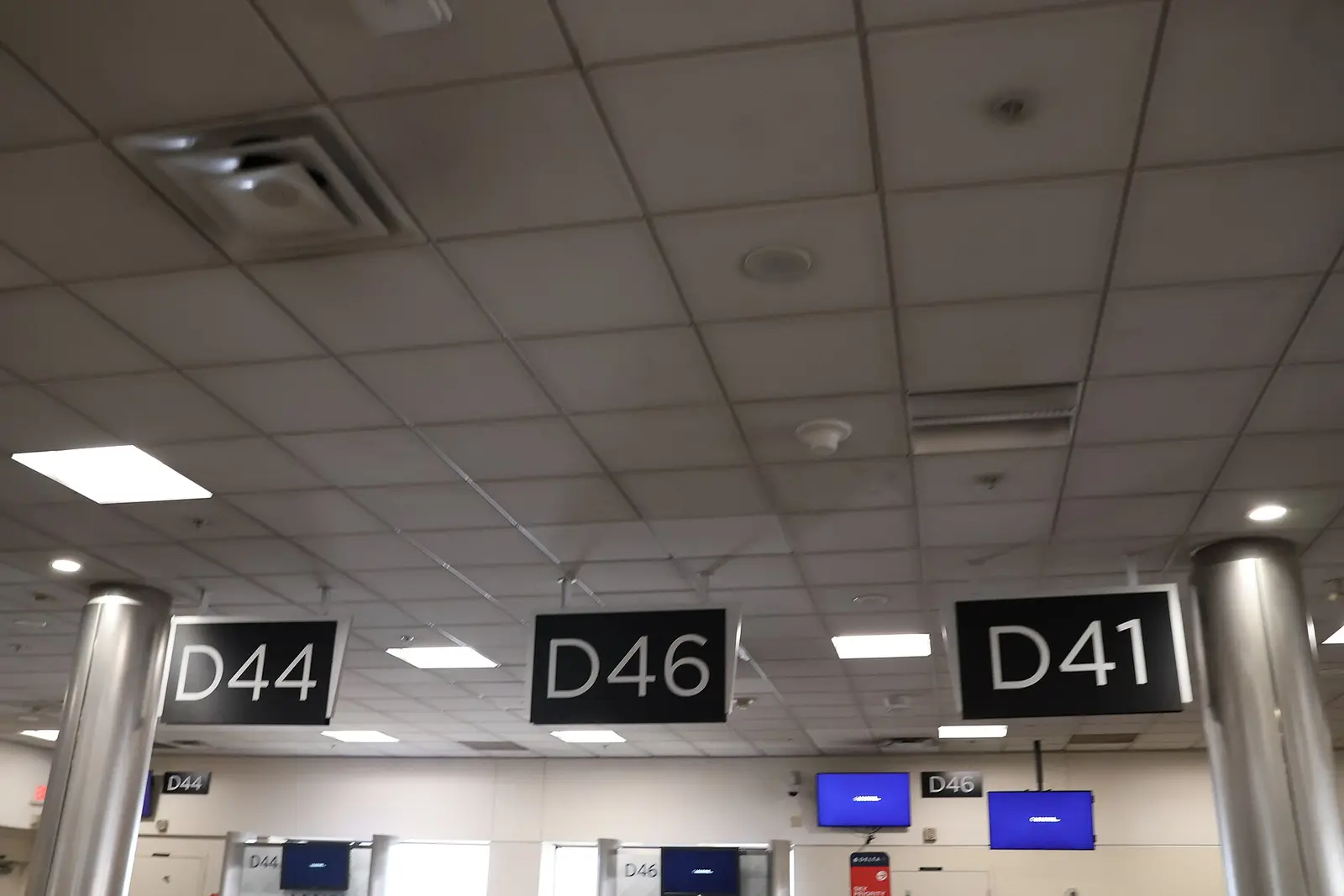
Atlanta is famous as the busiest airport in the world by passengers, yet in this data it is not even the busiest by departures. Hartsfield-Jackson scheduled 315,727 domestic departures over September 2025 to August 2026, behind 363,008 at O'Hare and 319,681 at Denver. That was the first surprise in the airport table when I built it. The difference is the connecting passenger: Atlanta moves enormous numbers of people through a relatively small number of very full flights.
Those departures ran 77.9% on time against 77.3% for all US flights, which put Hartsfield-Jackson 32 of the 60 airports with a page on this site. Middle of the table. The more interesting numbers sit underneath: 1.83% of departures were cancelled, 7.6% arrived an hour or more late (nationally 8.3%), and a late Atlanta departure averaged 66 minutes behind, against 73 nationally. Atlanta is late about as often as the country and late by less when it happens.
Every figure here covers flights departing Atlanta, scored at the gate they arrive at.
Delta's airport, and everyone else's
ATL average 77.9%
55.0%85.0%
Departures from ATL by carriers with at least 1,000 scheduled flights. The line is the airport average. Source: US DOT Bureau of Transportation Statistics, September 2025 to August 2026.
Delta flies roughly three of every four departures here, so Delta at Atlanta is, to a first approximation, the airport's record. It runs above the airport average, and it is the reason the average is respectable. Across its whole network Delta ran 81.1% on time, and the hub guide shows how Atlanta compares with Delta's other hubs.
One of the larger carriers by departures is a surprise: Frontier at Atlanta sits at the bottom of the chart, well below Delta. On the Atlanta to LaGuardia route, Frontier's flights ran far behind Delta's on the same route, and Frontier's 9pm departure, F9 3288, was one of the least punctual regular flights out of the airport. Southwest at Atlanta sits between the two, and United at Atlanta, a small operation feeding United's own hubs, runs close to Delta.
At Atlanta the carrier matters more than the airport.
A Frontier ticket out of ATL buys a different operation from a Delta ticket on the same route, and on the LaGuardia run I would take Delta's.
The day at Atlanta
Departures from ATL grouped by scheduled local departure time. Source: US DOT Bureau of Transportation Statistics, September 2025 to August 2026.
Dawn departures ran 88.3% on time and the 5pm to 8pm window 69.2%, a fall of 19.1 points against 21.3 points nationally. That is a slightly gentler slope than the average airport, which fits a hub whose first wave is made of aircraft that spent the night on the field.
The late-night window, after 8pm, recovers to 72.9%, and the recovery is structural. Delta runs a large late bank out of Atlanta, and by the time it pushes back the afternoon thunderstorms that hammer the Southeast in summer have usually moved through. Evening is the trough; late night is a partial recovery, not a safe harbour.
Flight numbers show the shape plainly. Delta's early departures to small Southeast cities, such as the 8:05am to Charleston, DL 3091, were among the most punctual flights out of Atlanta. The late-afternoon departure to O'Hare, DL 2879, was among the worst, carrying Atlanta's own afternoon storms into Chicago's evening congestion.
The calendar matters as much as the clock
Each month is one month of one year: August to December 2025, January to July 2026. Source: US DOT Bureau of Transportation Statistics, September 2025 to August 2026.
The best month was September at 86.5%, the worst July at 66.5%. That 20.0-point gap is at least as wide as Atlanta's gap between dawn and evening, so the month deserves as much thought as the hour. Atlanta in July is a thunderstorm month, the pattern the summer thunderstorm guide traces across the country: convection over north Georgia in the afternoon slows arrivals, holds departures and strands aircraft that were due to fly the evening bank. September at Atlanta is the opposite: the storms have gone and the leisure crowds with them.
Winter is less straightforward than it looks. January at Atlanta shows a respectable on-time rate of 78.3%, but the cancellation rate that month was several times the airport's annual figure. On-time rates are computed only over flights that operated, so an ice storm that grounds the airport simply disappears from the on-time column. In the South, winter risk arrives as cancellations, not delays.
One holiday stands out. Nationally, Memorial Day weekend 2026 ran 4.6 points worse than the weeks around it, and the airport table on that page puts Atlanta among the hardest hit. One weekend in one year is one storm system, not a pattern, but it is a reminder that a summer holiday at a thunderstorm hub has two ways to go wrong.
Weekdays
The best weekday was Wednesday at 84.2%, the worst Sunday at 72.3%. Atlanta's 11.9-point spread between them is among the wider weekday gaps of any large airport, and Monday (75.4%) is the second-weakest day. Both sit either side of Saturday, which at 78.3% is a steadier day. Tuesday (80.5%) and Wednesday are the days to book when the calendar lets you.
Where the delay minutes come from
Share of all delay minutes. Darker is a bigger share. Air traffic is the National Airspace System category; weather is extreme weather only.
Shares of all delay minutes reported by the airlines. Source: US DOT Bureau of Transportation Statistics, September 2025 to August 2026.
Atlanta's air traffic share, 22% of delay minutes, is level with the national 21%. For a hub of this size that is a quiet achievement: five parallel runways let the airport keep landing aircraft when others would be metering them.
The split between airline-caused delay (42%) and late-arriving aircraft (30%) looks inverted against the national 33% and 40%. I read that as a reporting convention, not a finding about Delta's operation: Delta's whole network shows the same tilt, with 44% of its delay minutes coded to the airline, and Endeavor Air, Delta's regional partner, never appears as a separate carrier at Delta's hubs in this data. Compare that with Charlotte and Dallas-Fort Worth, American's two biggest hubs, where late aircraft dominate.
Best and worst routes
The busiest routes out of Atlanta point at the airports that break schedules. Atlanta to Washington National ran 68.7% on time, Atlanta to Orlando 70.3%, Atlanta to O'Hare 69.0% and Atlanta to Fort Lauderdale 70.7%. LaGuardia, the single busiest destination, cancelled 4.34% of scheduled flights, more than double the airport's rate.
The routes that hold up go to calmer places. Atlanta to New Orleans ran 81.4%, Atlanta to Austin 81.0% and Atlanta to Nashville 79.6%. On Orlando, the busiest leisure route, Southwest's flights and Delta's run close; the evening departure matters more than the airline.
Connecting through Atlanta
For connecting passengers, Atlanta's inbound spokes are its best feature. Short hops from the Southeast and Ohio Valley are among the most punctual busy routes in the country: Greenville-Spartanburg to Atlanta ran 90.1%, Pittsburgh to Atlanta 89.2% and Louisville to Atlanta 89.6%. The inbound flights that miss connections come from the congested and storm-prone airports: Fort Lauderdale to Atlanta ran 71.0%, and at that rate I would not put a one-hour connection behind it. The connection risk calculator runs the numbers for a specific inbound flight, and the hub-by-hub table puts Atlanta in context against the other large hubs.
My call on Atlanta
Fly Delta if the choice is otherwise even. At Atlanta the carrier choice moves the number more than the airport choice ever could.
Leave before 11am in summer. From June to August the afternoon convection lands on the evening bank. A morning departure also leaves the rest of Delta's deep schedule available for rebooking.
Connect with at least 90 minutes when your inbound flight comes from Florida, New York or Washington. From a short Southeast spoke, 60 minutes is usually enough.
Treat January cancellations separately from delays. Book refundable or flexible fares for winter trips through Atlanta; a single ice storm cancels flights rather than delaying them.
Prefer Tuesday or Wednesday. On a trip with flexible dates it is a free 11.9-point swing.
Explore Atlanta: Hartsfield-Jackson (ATL) · Delta at ATL · ATL in July · Connection risk calculator · Charlotte airport guide