Guide
Philadelphia airport delays: how reliable is flying out of PHL?
PHL departures ran 75.2% on time, and when they were late they averaged 82 minutes behind. American's hub is late in long stretches, not short ones.

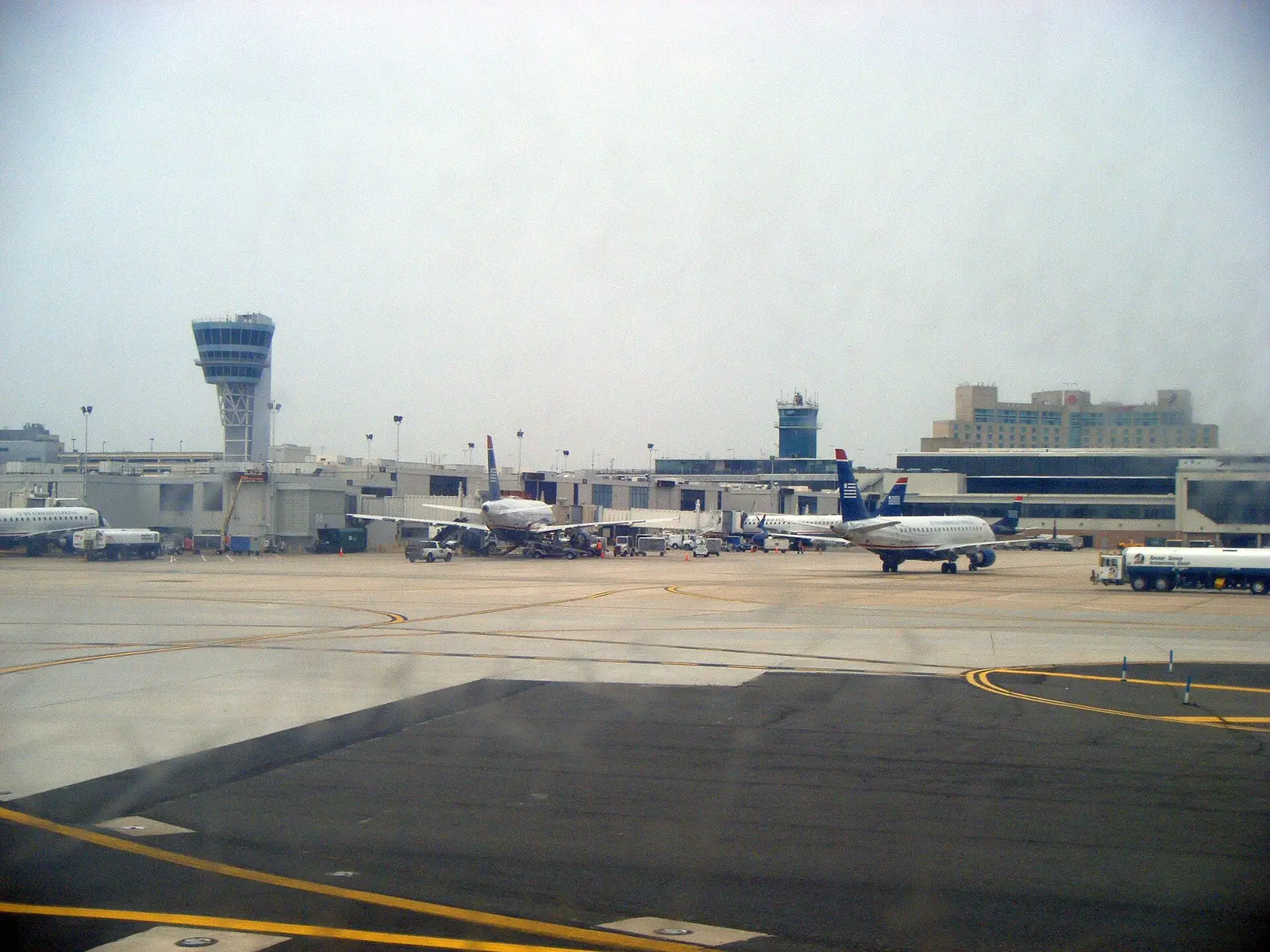
One of the least punctual routes on this site starts at Philadelphia. Philadelphia to Washington National, a regional hop of about 120 miles, arrived on time 55.9% of the time over September 2025 to August 2026, against 78.2% for the median route. It is a small route, a few flights a day, but it captures Philadelphia's character: a hub where short, tightly scheduled regional flying meets Northeast congestion at both ends. At 55.9% I would not put a connection behind that flight.
Philadelphia International ran 75.2% on time, ranking 47 of 60 airports with a page, and cancelled 3.09% of departures against 1.89% nationally.
The number that sets it apart is length.
When a Philadelphia departure was late it averaged 82 minutes behind, against 73 nationally, and 41.5% of its late flights were an hour or more late, against 35.4% at the median airport. The long-tail guide explains why that matters: a 20-minute delay is an inconvenience, a 90-minute one breaks a connection.
All figures here cover flights departing Philadelphia.
American's hub, and the carriers that beat it
PHL average 75.2%
60.0%85.0%
Departures from PHL by carriers with at least 1,000 scheduled flights. The line is the airport average. Source: US DOT Bureau of Transportation Statistics, September 2025 to August 2026.
American at Philadelphia runs close to half of all departures, and its regional partner PSA Airlines at Philadelphia adds a large share of the short flights. Both sit near the airport average, which is to say both run behind the national figure. PSA cancelled more than American here, which fits the pattern in the regional carriers guide: regional flying cancels more for structural reasons, and when a hub has to thin its schedule, airlines usually cut the smallest aircraft first.
The best records at Philadelphia belong to carriers that are guests. Delta and Republic, flying mostly to their own hubs, sit clearly above the airport average. Frontier at Philadelphia, a sizeable base, sits well below it. On the Philadelphia to Atlanta route, Delta's flights ran far ahead of Frontier's; the aircraft are going to the same airport over the same airspace.
The first wave is not a free pass
Departures from PHL grouped by scheduled local departure time. Source: US DOT Bureau of Transportation Statistics, September 2025 to August 2026.
Nationally, departures between 5am and 8am run 89.3% on time. At Philadelphia they ran 85.7%, one of the weaker first waves of any large airport. The day then follows the familiar slope down to 66.6% between 5pm and 8pm, a fall of 19.1 points.
A weak first wave means the problem is not only delay accumulated through the day. Many early Philadelphia departures head into New York, Boston and Washington airspace during its morning peak, which is consistent with a first wave that loses time to congestion at the far end. The dawn departure is still the best bet at PHL, but it does not carry the near-guarantee it does in Atlanta or Denver.
The late-night window recovers a little, to 69.7%, as the Northeast's evening arrival peak clears. That is small comfort for a connection: the last departures of the night have no later flight to rebook onto, so a cancellation at 9pm means a hotel. American's own record at the airport follows the same curve, which is expected when one airline flies this much of the schedule.
The best regular flights are early and short. Republic's 6am to Boston, YX 5740, and Delta's 6am to Detroit, DL 1540, were among the most punctual departures from the airport. Frontier's evening flight to San Juan, F9 4462, was among the least.
December and July
Each month is one month of one year: August to December 2025, January to July 2026. Source: US DOT Bureau of Transportation Statistics, September 2025 to August 2026.
The best month was September at 82.0%, the worst December at 65.3%, with July at Philadelphia close behind at 66.1%. December at Philadelphia was a holiday-volume month: the whole Northeast ran poorly over the 2025 Christmas and New Year window, which nationally ran 6.5 points worse than the weeks either side. July brings the East Coast's thunderstorm season, when a line of storms between Philadelphia and New York can close departure routes for hours.
Winter's cost shows up elsewhere. January at Philadelphia posted 75.5% on time, but with a cancellation rate several times the airport's annual figure. Flights that are cancelled do not count against the on-time rate, so a snowstorm improves the on-time column while it empties the departure board.
Weekdays
The best weekday was Tuesday at 80.8%, the worst Sunday at 71.0%. Thursday, at 72.0%, was nearly as bad as Sunday, while Wednesday ran 80.6%. The Tuesday-Wednesday pair is worth about 9.8 points over the worst day.
Where the delay minutes come from
Share of all delay minutes. Darker is a bigger share. Air traffic is the National Airspace System category; weather is extreme weather only.
Shares of all delay minutes reported by the airlines. Source: US DOT Bureau of Transportation Statistics, September 2025 to August 2026.
Late-arriving aircraft account for 43% of Philadelphia's delay minutes, above the national 40%, while the air traffic share, 22%, sits at the national level and below Newark and Boston. That is a hub-rotation profile, similar to American's other big hub at Charlotte. An aircraft that left Philadelphia late in the morning comes back late in the afternoon, and every bank it touches inherits the delay.
Best and worst routes
Among busy routes, Philadelphia to San Juan was the weakest at 63.3%. The Florida leisure routes follow: Philadelphia to Orlando at 72.4% and Philadelphia to Fort Lauderdale at 73.1%. Philadelphia to O'Hare, at 73.1%, joins two congested airports, and Philadelphia to Boston, at 74.5%, shows a clear carrier gap: Republic's flights ran well ahead of American's.
The best busy routes lead to well-run hubs: Philadelphia to Houston Intercontinental at 81.7%, Philadelphia to Charlotte at 80.2% and Philadelphia to Phoenix at 80.4%.
The Washington route this guide opened with is small enough to show whole.
data/generated/routes/PHL-DCA.json, trimmed to the headline fields
{
 "flights": 785,
 "completed": 741,
 "onTimePct": 55.9,
 "veryLatePct": 17.8,
 "avgDelayMin": 81.1,
 "medianArrDelay": 9,
 "cancelPct": 5.35,
 "divertPct": 0.25,
 "causes": {
  "carrier": 0.1947,
  "weather": 0.1088,
  "nas": 0.336,
  "security": 0.0013,
  "lateAircraft": 0.3592
 },
 "byHourBlock": [null, 82.8, null, 49.2, 61.1, 38.7 ],
 "byMonth": [50, 52, 41.4, 47.5, 55.7, 64.8, 37.7, 49.1, 83, 78.3, 33.9, 48.3 ],
 "byDow": [51, 59.4, 58.9, 44.9, 54.2, 74.3, 48.6 ]
}
Percentages are shares of scheduled or completed flights as defined on the methodology page; byHourBlock runs 5am to overnight, byMonth January to December, byDow Monday to Sunday. Source: US DOT Bureau of Transportation Statistics, September 2025 to August 2026.
This is the file my pipeline writes for the route. Each month it downloads the DOT's release, a zip of roughly 250 MB, and rebuilds this record from it along with every other figure in this guide.
Connecting at Philadelphia
Philadelphia is American's main gateway to Europe, and many passengers change planes here between a domestic flight and a transatlantic one. The domestic inbound leg is the weak link. Arrivals from Dallas-Fort Worth ran 71.4% on time and from O'Hare 70.8%, while westbound hubs with good records fed Philadelphia better: Phoenix to Philadelphia ran 84.7%.
Long delays are what make connections here risky: a late flight at Philadelphia is more often an hour late than at most airports, and an hour late breaks almost any domestic connection. The connection risk calculator runs the numbers for your own inbound route, and the missed-connection guide sets the busiest hubs side by side for comparison. For an international departure, I would leave three hours.
If I were flying out of PHL
Leave early, but do not assume early is safe. The first wave is still the best window, just not by as much as elsewhere.
Give connections room. Because PHL's late flights run long, 60 minutes is thin. Ninety is the practical minimum for a domestic connection, and more for a flight to Europe.
Check the non-American options. Where Delta or Republic flies your route from Philadelphia, their records here have been better than the hub carrier's.
Avoid San Juan and Florida on Frontier in the evening. These are the combinations where the airport, the route and the carrier are all at their weakest.
Explore Philadelphia: Philadelphia International (PHL) · American at PHL · PHL in December · Boston Logan guide · Connection risk calculator