Guide
Flying to ski country: which routes into the mountains run on time
Salt Lake City to Sun Valley ran 93.5% on time; Chicago to Aspen 59.4%. How routes into nine mountain resort airports compare, and where Aspen's cancellations come from.

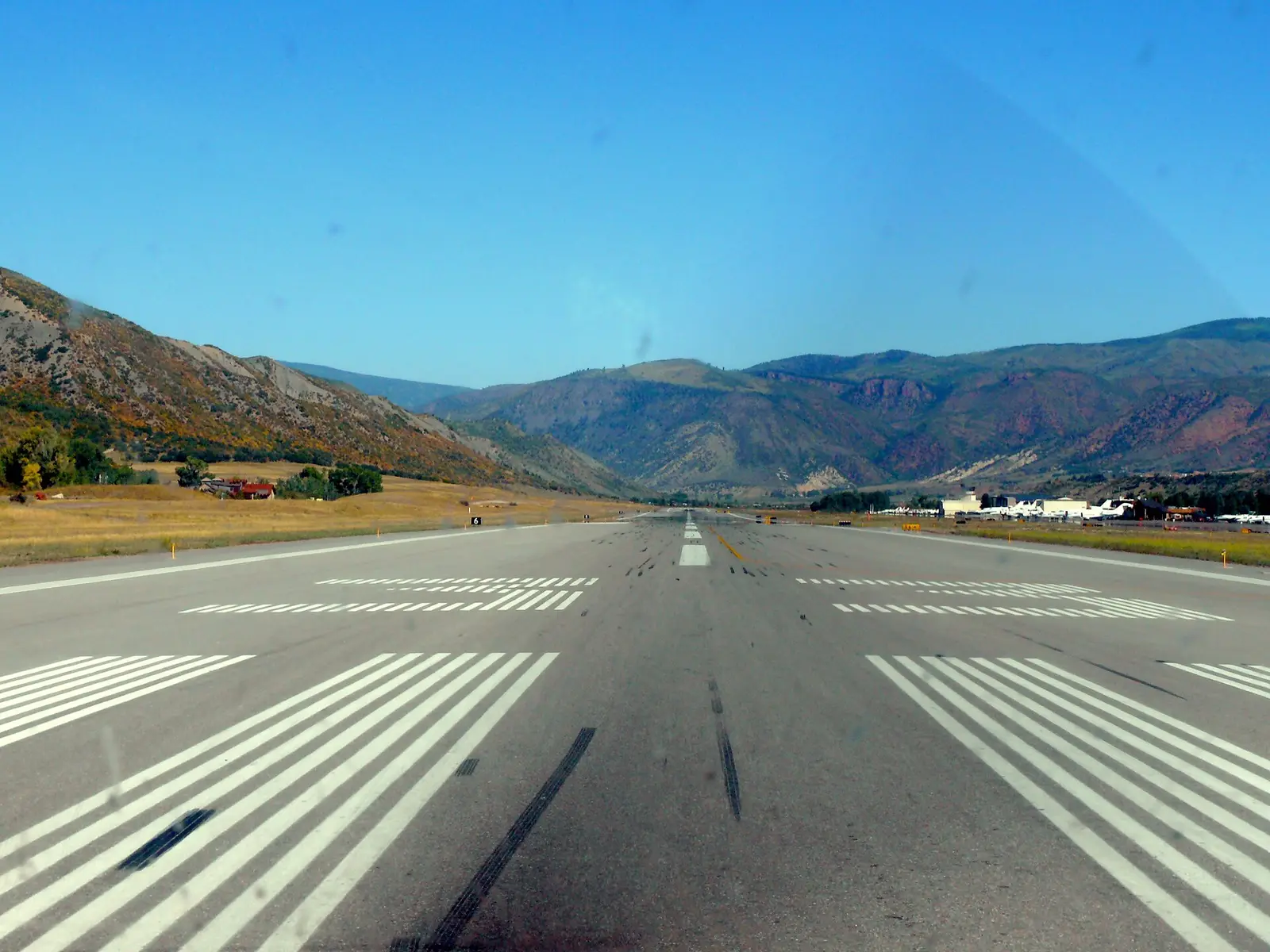
The most punctual way into ski country in this data was a SkyWest regional jet out of Salt Lake City. Salt Lake City to Sun Valley arrived on time 93.5% of the time, which ranked 8 of the 2,978 US routes with a page on this site. The long nonstop from Chicago O'Hare to Aspen managed 59.4%.
Those two routes bracket the choice every ski traveller makes: connect through a Mountain West hub onto a short flight, or pay for a nonstop from home that crosses half the country and lands at a mountain airport in the afternoon.
This guide compares routes into nine resort airports: Aspen (ASE), Eagle/Vail (EGE), Hayden/Steamboat (HDN), Montrose/Telluride (MTJ), Gunnison/Crested Butte (GUC), Jackson Hole (JAC), Bozeman/Big Sky (BZN), Sun Valley (SUN) and Glacier Park/Whitefish (FCA). The DOT measures arrival at the gate, less than 15 minutes late counting as on time, and route figures cover one direction only. Flights into the mountains and flights out of them are separate routes with separate records.
Short hops from Salt Lake City lead; long nonstops trail
US average 77.3%
50.0%100.0%
Source: US DOT Bureau of Transportation Statistics, September 2025 to August 2026.
The table sorts itself into three groups. At the top sit the Salt Lake City feeders: Salt Lake City to Glacier Park at 88.6%, Salt Lake City to Bozeman at 88.5% and Salt Lake City to Jackson Hole at 86.8%. In the middle are Denver's short feeders, from Denver to Jackson Hole at 82.4% to Denver to Hayden at 72.9%. At the bottom are the long nonstops from the big hubs: Dallas/Fort Worth to Eagle at 64.3%, Dallas/Fort Worth to Jackson Hole at 62.6% and Chicago O'Hare to Aspen.
Distance is not the explanation on its own. The mechanism is where the aircraft has been and what it leaves from.
A Salt Lake City feeder departs from one of the best-run big airports in the country: flights leaving Salt Lake City International ran 84.2% on time, number 1 of the 60 busiest US airports, against 72.8% at Dallas/Fort Worth and 70.8% at O'Hare. The flights are short, so there is little airborne time in which to lose minutes, and almost none of its delay is charged to air traffic control. Only 11% of Salt Lake City to Jackson delay minutes fell in the DOT's National Aviation System category.
The long nonstops inherit everything their origin hub throws at them. Late-arriving aircraft accounted for 53% of delay minutes on Dallas to Eagle, meaning the plane was already behind when it reached the gate at DFW. By the time it lands in the Rockies, by midday or later, it has carried a hub's morning into a mountain airport's weakest hours.
Aspen: the cancellation problem
On-time rates count only flights that operated. At Aspen the bigger risk is the flight that does not.
US average 1.89%
0.00%6.00%
Source: US DOT Bureau of Transportation Statistics, September 2025 to August 2026.
Denver to Aspen cancelled 5.11% of its scheduled flights, and Dallas/Fort Worth to Aspen 4.47%, against 1.89% for all US flights. Denver to Eagle, the run to the Vail valley, cancelled 0.34%. Departures from Aspen itself were cancelled at 5.79%, the highest of the nine resort fields in this data.
Aspen's airport explains most of that. It has a single runway at nearly 7,800 feet, boxed in by terrain on three sides, with an approach that needs better visibility than most airports require before an aircraft can attempt it. Wingspan and weight limits restrict which jets can use it, and thin air on a warm day cuts what they can carry. When low cloud or snow sits in the valley, flights do not wait; they cancel or turn back. A flight that returns to its departure airport counts as a diversion in the DOT file, and I leave diverted flights out of the on-time rate, so Aspen's on-time figure understates what its passengers went through. The diverted flights guide ranks those routes separately. The cause codes fit: 22% of Denver to Aspen delay minutes were charged to extreme weather, against 6% nationally.
Eagle, about 70 miles away by road, has a longer runway on a wider valley floor, and it shows in the record. So do Hayden and Montrose, where Denver to Hayden cancelled 0.49% and Denver to Montrose 0.14%. Their on-time rates are similar to Aspen's; their completion rates are far better.
data/generated/routes/DEN-ASE.json, trimmed to the headline fields
{
 "flights": 2742,
 "completed": 2563,
 "onTimePct": 74.2,
 "veryLatePct": 11.6,
 "avgDelayMin": 95.8,
 "medianArrDelay": -6,
 "cancelPct": 5.11,
 "divertPct": 1.42,
 "causes": {
  "carrier": 0.2447,
  "weather": 0.2175,
  "nas": 0.2594,
  "security": 0,
  "lateAircraft": 0.2784
 },
 "byHourBlock": [86.5, 77.6, 72.5, 73.9, 70.8, 77.2 ],
 "byMonth": [80.5, 73.7, 83.9, 85.8, 83.1, 61.6, 58.2, 60.3, 80.3, 83.1, 87.6, 63.7 ],
 "byDow": [74, 82.8, 79, 72.1, 74.9, 69.2, 68.2 ]
}
Percentages are shares of scheduled or completed flights as defined on the methodology page; byHourBlock runs 5am to overnight, byMonth January to December, byDow Monday to Sunday. Source: US DOT Bureau of Transportation Statistics, September 2025 to August 2026.
That is the file my pipeline writes for Denver to Aspen, cancellation and diversion rates included; it is rebuilt from the DOT's monthly files each time a new month arrives.
The winter months, with a warning about sample size
US average 79.2%
40.0%95.0%
Source: US DOT Bureau of Transportation Statistics, September 2025 to August 2026.
Resort routes are small. Across the year they carry roughly 709 to 2,742 flights each, which means anywhere from a few dozen to about 300 in a given month. One snowstorm on a Saturday changeover can move a month's figure by ten points. Read the monthly numbers as the record of one winter, not the character of the route.
With that said, December was rough almost everywhere outside Salt Lake City. Chicago O'Hare to Aspen ran 45.4% in December and Dallas/Fort Worth to Eagle 44.3%. Denver to Aspen ran 63.7% in December before recovering to 80.5% in January and 83.9% in March. The Salt Lake City feeders held up: Salt Lake City to Sun Valley ran 96.5% in December and Salt Lake City to Jackson Hole 91.8%. The holiday weeks combine peak volume at the hubs with the first big storms of the season, and the long nonstops take both.
DEN → ASE74.2% overall
SLC → JAC86.8% overall
DFW → EGE64.3% overall
ORD → BZN68.2% overall
All panels share one scale, 35% to 100% on time. Source: US DOT Bureau of Transportation Statistics, September 2025 to August 2026.
Summer deserves a note too. Denver to Aspen ran worse in July, at 58.2%, than in any winter month, consistent with afternoon thunderstorms over the Rockies closing the same terrain-limited approach. A summer trip to the mountains is not automatically the easy one.
What I would book for a ski trip
Connect through Salt Lake City or Denver, on the first bank. Arrive at the hub in the morning and take a midday feeder. If the connection fails, there is usually a later flight the same day; from a long nonstop there often is not.
Arrive a day before anything you have paid for. Ski school, a lift-ticket start date, a rental with a fixed pickup: none of them move for a cancelled flight. On routes cancelling several percent of flights in winter, a spare day is the cheapest insurance available.
For Aspen, price Eagle and the drive. Eagle's cancellation rate is a fraction of Aspen's, and the road between them is about an hour and a half. With Denver to Aspen cancelling 5.11% of its flights, I would fly into Eagle. For Steamboat, Hayden sits about 25 minutes from the resort. For Park City and the Cottonwood Canyon resorts, Salt Lake City itself is the ski airport, under an hour away.
Consider driving from the hub. Denver to Vail is about two hours on I-70 in good conditions, though the interstate has its own storm closures. Bozeman to Big Sky is about an hour. Sometimes the most reliable last leg has wheels.
Take the morning flight into the mountains. On Denver to Aspen, departures between 5am and 8am ran 86.5% on time and those between 5pm and 8pm 70.8%. Afternoon wind and weather at mountain airports compound the usual evening decline.
Buy flexibility. A fare that allows a free change to the day before is worth more on these routes than almost anywhere else in the country. Keep every leg on one ticket, so a cancelled feeder is the airline's problem to solve. The booking guide covers the mechanics, and the Mountain West hubs guide covers the connecting airports themselves.
Compare the routes: Salt Lake City to Jackson · Denver to Aspen · Denver to Eagle · Dallas/Fort Worth to Eagle · Chicago to Aspen · Compare any US route